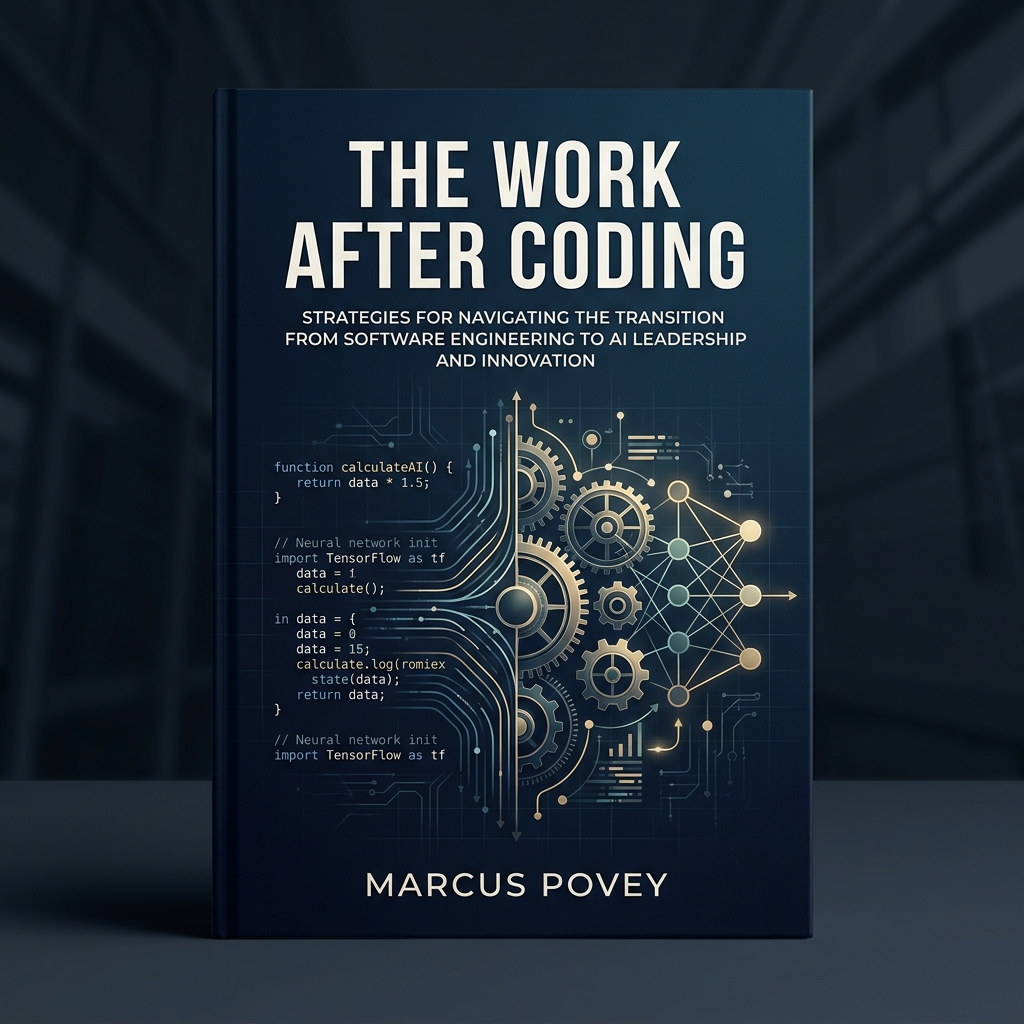
The Work After Coding
AI is making coding cheaper.
That does not mean building the right thing has become easy.
A warts-and-all field report for founders, consultants, and business owners on AI impact on software teams and technical leadership.
AI is making coding cheaper.
That does not mean building the right thing has become easy.
A warts-and-all field report for founders, consultants, and business owners on AI impact on software teams and technical leadership.

Not selling hype. Honest field notes from inside the shift in software development with AI.
Hi, I'm Marcus Povey from Practical Alchemy.
I've led software teams building real scientific software, with decades of practical experience. I run a long-running blog on software, open source, and technology, and I'm actively using AI in workplace tools and workflows today.
This book is an exploratory account of what happens when AI starts changing how we manage and build technical work. It provides practical insights for founders trying to understand managing AI development.

Businesses are adopting AI faster than they understand it.
Code and implementation are becoming easier to generate. But founders and consultants still need to know what is worth building and where human judgment still matters. The danger is that organisations mistake code-shaped output for software capability—a critical challenge in software development with AI 2025.

Practical guidance for founders, consultants, and business owners.
Understand which skills are becoming commoditised and which are becoming more valuable. Learn from real experiments and shifts in how software work is bought, sold, and managed by technical leaders.
A breakdown of the real-world impact of AI on teams, development workflows, and businesses.
Navigating the gap between flashy AI demos and production reality, and what happens when implementation becomes cheap.
How to introduce AI into a real team: bounding use cases, defining risk, and building review habits for managing AI development.
Moving from blank-page implementation to decomposition, orchestration, and the critical role of the human-in-the-loop.
What to let go of, and what to protect: system understanding, taste, and the ability to simplify complex problems.
Identifying security gaps, confident nonsense, and plausible but wrong architecture in AI-generated code.
The uncomfortable shift from selling code implementation to selling judgment, strategy, and technical leadership.
Get the field notes before the book.